![[:en]The flag of Denmark.[:]](https://www.landroutes.net/wp-content/uploads/2023/12/DALL·E-2023-05-31-07.08.52-flag-of-Denmark.webp "Denmark 1")
Denmark
Information about getting around
in Denmark
Here you can find information about the night train connection between Malmö and Hamburg: https://nachtzug.net/en/hamburg/
Follow train departure and arrival times between Denmark, Skåne and Central Europe:
Rejseplanen
Here you can find a lot of information about road traffic in Denmark. Train timetables, delays, etc.
Connections to Sweden
You can travel between Sweden and Denmark by car, train and ferry.
There are several ferry companies operating between Sweden and Denmark. Here are the main ones:
Stena Line – One of the largest ferry companies, operating routes such as Gothenburg-Frederikshavn and Halmstad-Grenå.
Oresundslinjen – This company operates the Helsingborg-Helsingør route, which is one of the busiest routes.
Bornholmslinjen – Offers ferry connections from the island of Bornholm to Sweden
Zugfinder. On these pages you will find information about high-speed trains from Germany, Austria, Slovenia, Denmark, the Netherlands, Italy, Luxembourg and Belgium, Eurostar and the locations of regional and long-distance trains on several German railway lines
![[:en]People on the Copenhagen metro.[:]](https://www.landroutes.net/wp-content/uploads/2024/10/Koopenhamina41-1-1024x768.webp "Denmark 3")
Major Routes Between Sweden and Denmark
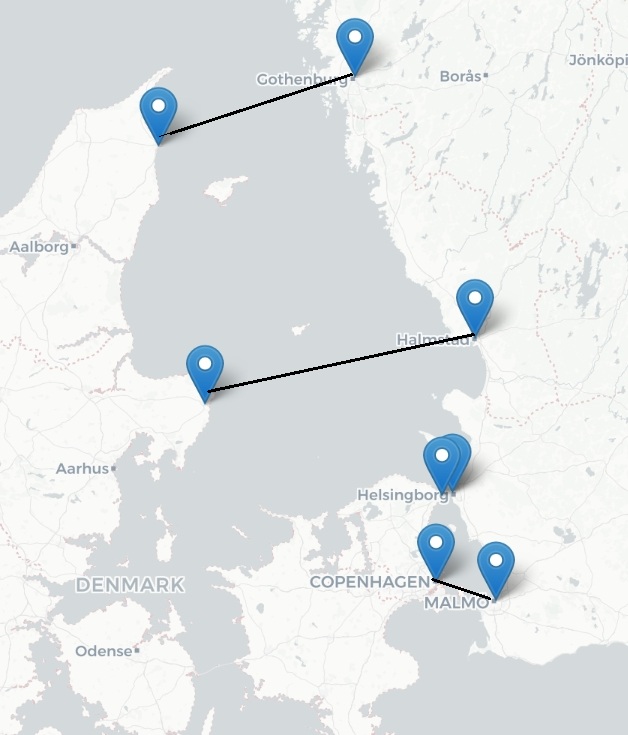
The Northern Connection: Göteborg – Frederikshavn (Ferry) This is the optimal route for travelers wishing to bypass the island of Zealand entirely. By arriving in Frederikshavn, you gain direct access to the Jutland peninsula, making it a strategic choice for those driving from western Sweden toward Germany and mainland Europe. The crossing takes approximately 3 hours and 15 minutes.
The Central Route: Halmstad – Grenaa (Ferry) This serves as an alternative gateway to eastern Jutland. However, it is important to note that this service is scheduled to discontinue operations on April 30, 2026. Travelers planning trips after this date should look to the Gothenburg or Helsingborg crossings.
The High-Frequency Link: Helsingborg – Helsingør (Ferry) Known as the “HH-route,” this is one of the busiest ferry crossings in the world. Operating like a “floating metro,” it provides a near-constant connection between North Zealand and Skåne. With a sailing time of just 20 minutes, it is favored by locals and tourists alike for its efficiency and scenic maritime atmosphere.
The Primary Vein: Malmö – Copenhagen (Øresund Bridge) The bridge remains the fastest and most vital link between the two nations, specifically connecting the metropolitan hubs of Malmö and Copenhagen. It is the only fixed link, making it the essential route for high-speed trains and heavy road traffic. For those prioritizing speed, the crossing takes only about 15 to 20 minutes.
Reservations and planning
Here are some websites:
Passenger train services
In Denmark, passenger train services are mainly operated by two companies: Danske Statsbaner (DSB) and Arriva Denmark.
About bus transport
Denmark is also home to a number of important bus companies that offer comprehensive bus services across the country.
Denmark is made up of many parts
Denmark has a total area of about 43,094 square kilometers. This figure includes both the Jutland Peninsula and the Danish islands, which are located between Sweden and Germany.
Denmark has a population of about 5.8 million people. The majority of the population lives in the largest areas, such as Zealand, Jutland and Funen, where the largest cities are also located.
The islands make up a third of Denmark's area
Denmark consists of the Jutland Peninsula and about 406 islands. Of these islands, 78 are inhabited. The largest islands are Zealand, Vendsyssel-Thy, Funen, Lolland and Bornholm.
Gateway to Europe
There are many seashores along the North Sea and Baltic coasts. Denmark is one of the Nordic countries. Finland, Sweden and Norway's road to Europe goes through Denmark
The three largest cities in Denmark
Copenhagen is home to approximately 1.38 million people. Aarhus has approximately 296,000 inhabitants. The third largest city is Odense, with a population of about 184,000 people.
Denmark is a large country
Including all the territories that are part of the Danish state, such as Greenland and the Faroe Islands, Denmark's total area is approximately 2,210,573 square kilometers.
The largest regions of Denmark
Zealand is Denmark's largest island, where Copenhagen is also located. This area is the most densely populated and economically significant. Jutland covers most of Denmark's territory. The cities of Aarhus and Aalborg, among others, are located here. Funen is the third largest island, connecting Zealand and Jutland.
Greenland and the Faroe Islands have only a small proportion of inhabitants
Greenland has a population of about 56,000 people and the Faroe Islands about 53,000 people. In total, the population of the areas belonging to the Danish state is therefore about 5.9 million.