Vienna is the capital and also one state in Austria
![[:en]People in the subway tunnel of Vienna.[:]](https://www.landroutes.net/wp-content/uploads/2024/11/Wien4-scaled.webp "Vienna 1")
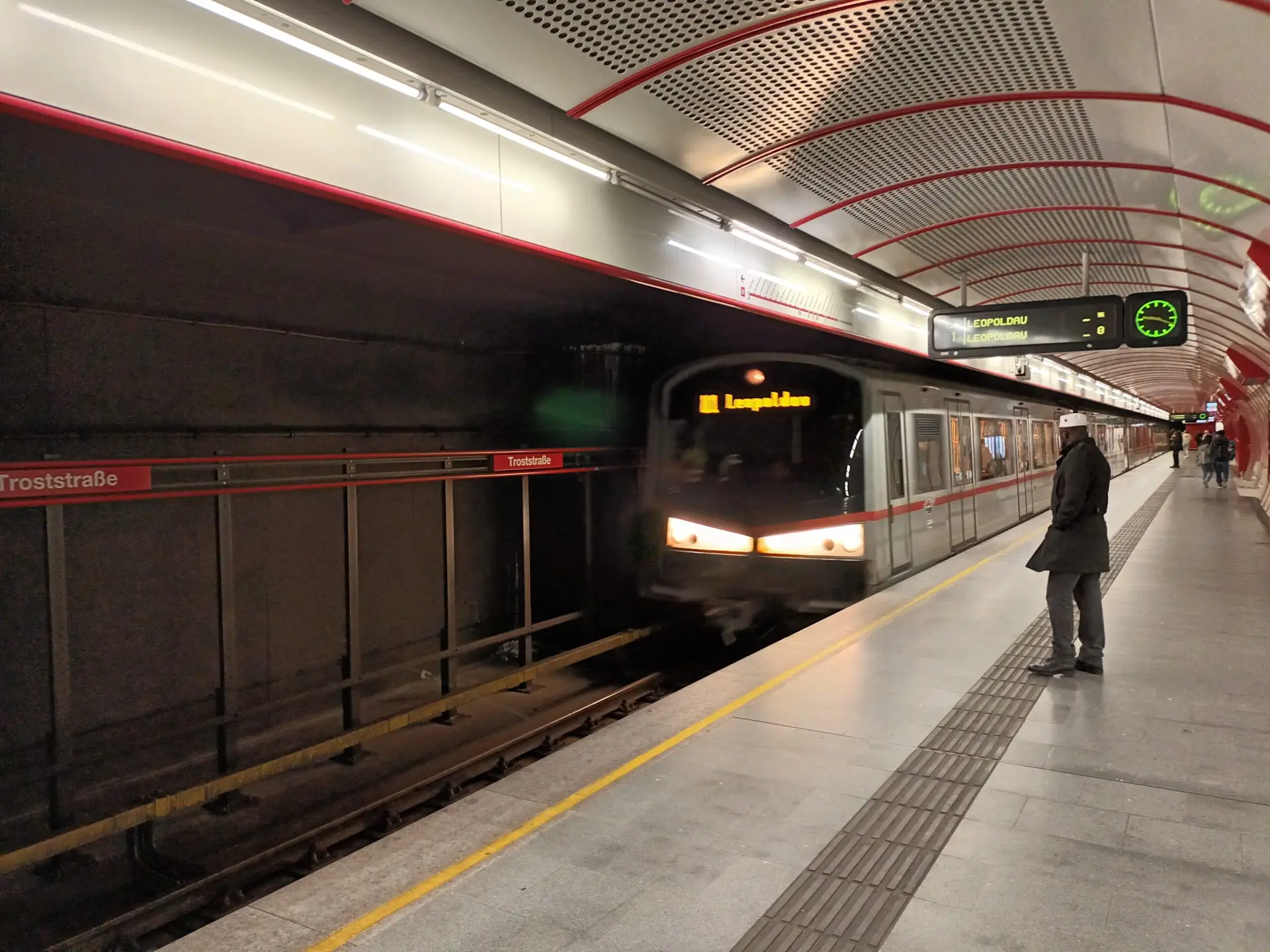
![[:en]The subway train arrives at the station in the Vienna underground. People are chatting on the platform.[:]](https://www.landroutes.net/wp-content/uploads/2025/05/Wien501-scaled.webp "Vienna 3")
![[:en]People at Vienna's main train station.[:]](https://www.landroutes.net/wp-content/uploads/2025/05/Wien621-scaled.webp "Vienna 4")
People in the Vienna Central Staion and metro.
Location: The station is situated in a central location in Vienna and connects four major railway lines coming from the north, east, west, and south.
Services: Vienna Hauptbahnhof offers a wide range of services, including shops, restaurants, and passenger services. The station is designed to accommodate a large number of travelers and provides modern amenities.
Transport Links: The station is a key hub for both local and international train connections. There are direct links to many European cities, such as Berlin, Budapest, Prague, and Munich.
Public transportation in Vienna is mainly overseen by Wiener Linien. Wiener Linien is a municipal entity that operates the city’s metro, trams, buses, and local trains. They also manage the ticketing system and maintain the transportation network.
Various companies provide passenger train services in Vienna, with Österreichische Bundesbahnen (ÖBB), or the Austrian Federal Railways, being a prominent one. ÖBB offers a diverse range of train services, including regional, long-distance, and international options.
In the bus sector, multiple companies operate in Vienna, but notable ones alongside Wiener Linien include Postbus and Blaguss. These companies run several bus lines, connecting the city to surrounding regions.
The Vienna metro system offers a fast, reliable, and convenient way to move around the city. With its five lines covering the entire urban area, the metro is an essential mode of transport for discovering Vienna’s attractions.
Night Train to Vienna: schedule and train connections (nachtzug.net)
Vienna’s train services are highly extensive and efficient, offering excellent connections both locally and internationally. Vienna’s main railway station, Hauptbahnhof, is a key transportation hub from which trains depart and arrive to various parts of Austria and Europe.
Local trains and S-Bahn
Vienna has a vast local train network known as the S-Bahn. S-Bahn trains run frequently and connect different parts of the city as well as surrounding areas. For example, the S7 line connects Vienna city center with Vienna International Airport.
Long-distance trains
There are direct train connections from Vienna to many European cities, such as:
Berlin: The journey takes about 8 hours.
Budapest: The journey takes about 2.5 hours.
Prague: The journey takes about 4 hours.
Munich: The journey takes about 4 hours.
ÖBB and Westbahn
Austrian Federal Railways ÖBB (Österreichische Bundesbahnen) provides a wide range of train connections. Additionally, the private railway company Westbahn offers competitive options, especially between Vienna and Salzburg.
Tickets and schedules
Train tickets can be easily purchased online, at stations, or via mobile apps. Schedules and routes can be found on the ÖBB website.
Vienna’s train services are known for their reliability and comfort, making them an excellent choice for both locals and travelers.
Vienna has a comprehensive metro system consisting of several lines. The metro is a fast and efficient way to get around the city, connecting different parts of Vienna. Metro services are especially popular during rush hours as they provide a quick way to avoid traffic jams. Metro stations usually have clear signage and information systems as well as ticket machines.
Additionally, Vienna has an extensive tram system that covers a large part of the city. Trams offer a convenient way to travel locally between different neighborhoods. Furthermore, there are plenty of local buses serving various parts of the city, especially areas not covered by the metro and trams.
For all modes of transport, you can purchase various tickets and travel cards that cover different time periods and zones, allowing you to choose the option that best suits your travel needs. Vienna’s public transport system is well-organized and efficient, making it relatively easy and convenient to get around the city.
Vienna is a large city in Austria
The population of Vienna is about two million residents. This makes it the largest city in Austria and a significant center for culture, economy, and politics. All of Austria has only nine million residents.
Center for Classical Music
In Vienna, Haydn, Mozart, Beethoven, Schubert, Strauss, Brahms, and Gustav Mahler have lived and composed in turn.
Global Institutions
The city hosts international organizations, such as the International Atomic Energy Agency (IAEA) and the Organization of the Petroleum Exporting Countries (OPEC).
Capital and city-state
Austria has nine federal states, one of which is Vienna. This means that Vienna has its own administration, responsible for both city and state affairs.
Between the Alps and the Carpathians
Vienna is located between the Alps and the Carpathians along the Danube River. The Danube flows through the eastern parts of Vienna in a canalized channel a few kilometers from the city center.
Numbered neighborhoods
The districts of Vienna are numbered, with the smallest numbers located in the city center. The first district, Innere Stadt, is the historical center of Vienna.
The hills of Wienerwald protect Vienna
The hottest months are July and August, when the average high temperature is around 25 degrees.
![[:en]BeWelcome logo[:]](https://www.landroutes.net/wp-content/uploads/2025/03/BeW_eng-png.webp)